Why Your Glaze Slurry Separates, Settles, or Thixotropes:The Real Problem Is Your Suspending Agent "Structure"
"Chuan, my glaze slurry is impossible to work with. When I first prepare it, it's fine. But after two or three days, there's clear water on top, hard sediment at the bottom, and a sour smell in the middle. The workers say it's too thick to stir properly. When they spray it, the glaze coverage is uneven-some areas darker, some lighter-and we've lost a lot of production."
He tried switching CMC brands, adding preservatives, and even extending ball-milling time by half an hour. Nothing worked.
He asked me:
"Is it because the weather is hot and there's too much bacteria?"
I told him:
Heat is only a catalyst. The real issue is not bacteria. The real issue is that your suspending agent never truly managed to support the glaze slurry.
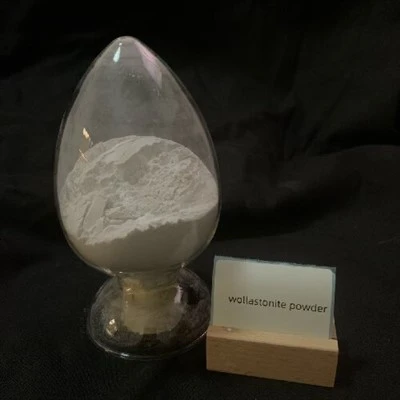
Today, I'll explain this using two materials:halloysite and high-whiteness bentonite.

What Actually Happens When Your Glaze Slurry "Goes Bad"?
If you leave a prepared glaze slurry standing for two days,
you may see one of three problems:
Hard Sediment
Heavy particles such as feldspar, quartz, and frit settle to the bottom and form a hard layer that is difficult to re-suspend.
This happens because the suspending agent does not have enough structural strength to hold the particles in place.
Water-Glaze Separation
Clear water floats to the surface, while the lower layer becomes bean-curd-like.
This is the most serious condition.
It means that the network structure of the suspension system has completely collapsed, and water has separated from the solids.
Excessive Thixotropy
When freshly stirred, the slurry may be thin and fluid. But after standing for half an hour, it becomes too thick, like paste.
In this case, the glaze may not spray smoothly, and the coating may not flow evenly during glazing.
If there is also a sour smell or foaming, organic additives such as CMC are likely being decomposed by bacteria.
Why Traditional Suspending Agents Are Always a Headache?
How did we solve suspension problems in the past? We either added CMC, common bentonite, or kaolin. Each of them has its own problems.
CMC: Cheap and easy to use, but it's a "delicate" material. It is sensitive to acids, alkalis, high temperatures, and bacteria. In summer, it can go sour after just two days. Moreover, it relies on molecular chain entanglement. Once subjected to shear forces such as stirring and pumping, the molecular chains break, and the suspension effect drops sharply.
Common bentonite (such as that produced in Liaoning and Inner Mongolia): It has strong thickening properties, but it is grayish-yellow in color and contains high levels of iron and titanium impurities. If you add it to white glaze, the glaze surface will become dirty. Moreover, it requires sodium modification; otherwise, its water absorption and swelling performance will be poor.
Ordinary kaolin:Its whiteness is acceptable, but it has a plate-like structure. In water, the plate-like particles are like a stack of plates-once washed by water, they disperse and cannot support heavy particles. That's why many people report: "No matter how much kaolin I add, the glaze still settles."
So, is there a material that is non-toxic, non-putrefactive, non-fading, and naturally has a "network structure" that can firmly lock particles?
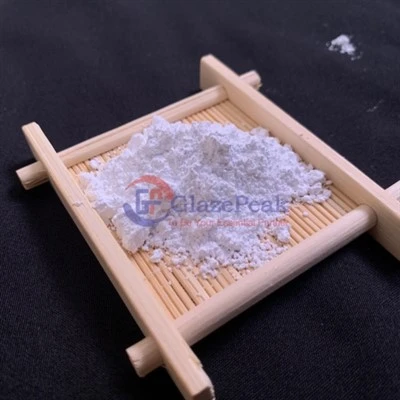
Yes, there is. Recently, I've been studying a type of mineral-I call it Suspending Agent No. 1.
My Mineral: Tubular Structure, Naturally "Weaving a Network"
Let me start with a simple analogy. Have you ever seen a pile of straws?
When poured together randomly, they interpenetrate and entangle with each other, forming a loose "yarn ball." Water can pass through, but large particles are trapped and cannot settle.
The mineral I'm talking about behaves exactly like these "straws."
Its chemical composition is the same as that of kaolin, but its crystals are tubular, not plate-like. These nanotubes are several hundred nanometers long and tens of nanometers in diameter-like tiny hollow straws.

Ordinary kaolin is plate-like, like a pile of plates. This mineral is tubular, like a pile of straws. Plates stacked together will disperse when washed by water; straws entangled together remain intact even when flushed. This is the fundamental reason for its excellent suspension performance.
Review the Test Data
Below is the analysis certificate of this imported material (see figure):
Loss on Ignition (LOI): 15.74%
Al₂O₃: 38.05%
SiO₂: 44.28%
Fe₂O₃: 0.61% (very low, no adverse impact on whiteness)
Other impurities: less than 0.1%
It features high whiteness and low iron & titanium content, fully suitable for white glaze and transparent glaze applications. Comparison between Ordinary Kaolin and Halloysite (Suspending Agent No.1)
| Characteristics | Ordinary Kaolin | Halloysite (Suspending Agent No.1) |
|---|---|---|
| Crystal Morphology | Plate-like (like plates) | Tubular (like straws) |
| Suspension Mechanism | Relies on fine particle size, prone to settling | Forms a 3D network for physical particle trapping |
| Impact on Whiteness | Good | Superior (lower iron & titanium content) |
| Resistance to Bacterial Degradation | Natural mineral, non-biodegradable / non-putrefactive | Natural mineral, non-biodegradable / non-putrefactive |
| Sensitivity to Shear Force | Insensitive | Insensitive (avoid over ball-milling) |
| Price | Low cost | Imported, relatively high price |
This Mineral: High-Whiteness Bentonite - Thickens, Enhances Strength, and Will Not Contaminate Glaze Surfaces
Suspending Agent No.1 excels at supporting solid particles, yet its thickening capacity is limited. If you need to increase glaze slurry viscosity (for example, to prevent glaze running and improve hiding power), you will need a complementary material: high-whiteness bentonite.
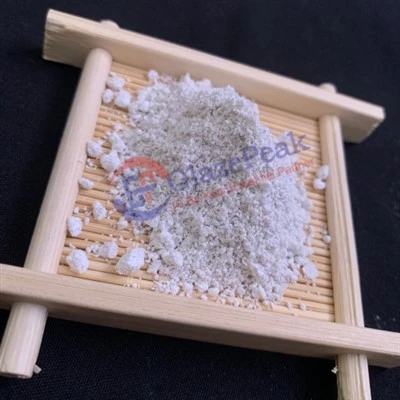
This is not the common grey-yellow bentonite. It is a mineral naturally associated with kaolin. That means it contains both montmorillonite (the thickening component of bentonite) and high-alumina, high-whiteness fractions from kaolin.
Thickening function: Montmorillonite swells upon contact with water to form a denser network, complementing halloysite.
High whiteness: As it coexists naturally with kaolin, iron and titanium impurities are diluted. It is far whiter than conventional bentonite and will not introduce yellow or grey discoloration when added to white glaze.
High strength: Its high alumina content (derived from kaolin) improves the hardness and wear resistance of the fired glaze surface.

We do not have its full analytical certificate, but practical testing shows its whiteness reaches nearly 85, and its iron content is approximately half that of ordinary bentonite. It can be safely used for white glaze and transparent glaze.
When blended with our suspending agent at a 1:1 ratio and added to glaze slurry, the combined system delivers multiple benefits: no settling, no water-glaze separation, good suitability for both spray glazing and curtain glazing, and high fired glaze strength. Both components are natural minerals, avoiding the common drawbacks associated with CMC.
How to Use? Three Practical Recommendations
Plan 1: Solve Sedimentation Only
Use halloysite alone. Dosage: 0.5–1.0% based on the weight of dry glaze raw materials.
Ball milling note: Halloysite is fine, and its tubular structure can be damaged by over-grinding. It is recommended to ball mill other raw materials first, then add halloysite for mild dispersion in the last 30–60 minutes. If halloysite has to be added from the start of ball milling, reduce total milling time by 10–15%, and verify suspension performance via small batch tests.
Plan 2: Prevent Sedimentation & Increase Viscosity
Blend halloysite and high-whiteness bentonite at a 1:1 ratio, total dosage: 0.8–1.5%. Halloysite builds the network framework while bentonite fills the network pores. Both materials can be added together during ball milling, yet halloysite is still recommended to be added at the later stage.
Plan 3: Fully Replace CMC
If you are troubled by CMC spoilage and performance failure, CMC can be completely substituted with the halloysite + high-whiteness bentonite system. However, you need to re-adjust the rheological parameters of glaze slurry. Small trials are strongly recommended in advance.
Important Reminder
When using new materials for the first time, always carry out small sample tests before mass production to confirm suspension stability and fired glaze quality.
There is no universal material; only processes that match your formulation. Halloysite comes with a relatively higher unit price, but its required dosage is low, leading to limited increase in overall cost.
Many customers find it cost-effective once they calculate the savings from reduced rework and rejected products.
Final Thoughts
Let me share some honest insights. I used to know little about "tubular structures" or "nano networks". Back then, I thought suspending agents were simply clay plus CMC.
After countless inquiries from customers, I spent a great deal of time reviewing literature and running practical tests. Eventually, I realized: suspension does not rely on viscosity or "stickiness", but on a network structure.
Plate-like ordinary kaolin is like a worn fishing net with oversized mesh openings, through which large heavy particles slip away. Halloysite, by contrast, acts like fine elastic stockings - it features tiny, flexible mesh to trap particles reliably.
Over years of glaze formulation work, I have grown convinced: selecting a material with the right microstructure matters more than endlessly tweaking dosage ratios.