



Wollastonite: More Than Just Lowering Firing Temperature – Understanding the Magic of Chain Silicate Minerals
Many of us working on ceramic body and glaze formulations, as well as building material recipes, have heard of wollastonite. It is a natural silicate mineral, named in honour of British chemist and mineralogist William Hyde Wollaston.
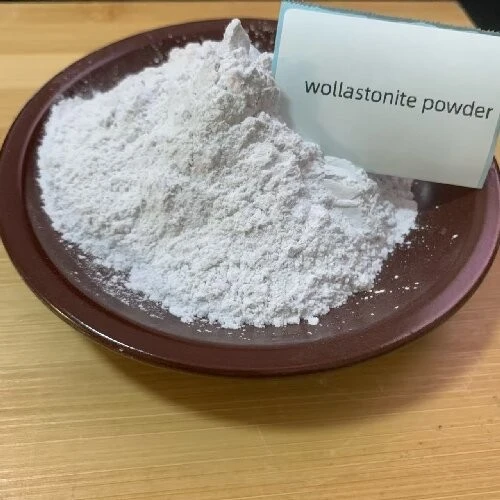
(Wollastonite Powder /Ceramic Grade Wollastonite)
Over my years working with various mineral raw materials, I've found that once the crude ore goes through beneficiation and purification, it works as a functional filler widely adopted in ceramics, building materials, glass, coatings, plastics, metal manufacturing and many other sectors. Wollastonite deposits can be found all over the globe, including China, Mexico, India, Spain and the United States.

Chemistry & Mineralogy
Wollastonite is formed by geological evolution. Silica and calcium carbonate react at roughly 450°C and gradually crystallise into this mineral. When I compare samples sourced from different deposits, I notice the final particle morphology of wollastonite largely depends on the geological origin of the ore, together with later beneficiation and grinding processes.
It is classified as a chain silicate with the chemical formula CaSiO₃. Its crystal structure consists of continuous (SiO₃)²⁻ silicate-oxygen long chains firmly linked by calcium cations.
Pure wollastonite forms colourless crystals in the triclinic crystal system. It forms via contact metamorphism of limestone and is a common mineral component found in metamorphic rocks.

Technical Performance
Wollastonite has a Mohs hardness of 4.5 and density of 2.85 g/cm³. Within the temperature range of 20–300°C, its thermal expansion coefficient is only 7×10⁻⁶/K with minimal expansion change. From my lab trial tests, I can clearly observe that it maintains stable performance even under working conditions with dramatic temperature fluctuations.
Reinforcement is one of wollastonite's standout strengths. When added into formulations, it noticeably boosts the mechanical strength of finished products, making it an extremely practical mineral raw material for industrial recipes. Besides, wollastonite features excellent chemical inertness and resists attack by a wide range of chemical media.

Material Characteristics
As a chain silicate, wollastonite's framework consists of infinite silicate-oxygen long chains built from silicate anions. These chains form banded structures with corner-connected SiO₄ tetrahedra. This linear silicate-oxygen chain structure creates wollastonite's unique material properties.
Its crystals have low symmetry, mainly triclinic, monoclinic or tetragonal; cubic crystal forms never occur. Crystals grow in prismatic or acicular shapes extending along the silicate chains, with well-developed cleavage in this direction.
Wollastonite is insoluble in pure water but undergoes slow alteration in salt water. Under certain conditions, the mineral can also fluoresce. It varies widely in appearance, occurring both massive and fibrous, normally light grey or milky white. Its crystals belong to the triclinic system. Low and stable thermal expansion is the core reason many formulation engineers choose this mineral.
Application Fields
Wollastonite for Ceramic Body & Glaze
Ceramic Industry
When formulating ceramic bodies and glazes, properly adding wollastonite for ceramic body & glaze can significantly reduce firing temperature. Ground wollastonite also shortens firing cycles and enables low-temperature fast single firing. This cuts substantial fuel consumption and lowers production costs accordingly.
Wollastonite contains no alkali metals. After firing, finished products deliver outstanding electrical insulation, high impact resistance and good dimensional stability. Thanks to these advantages, we often see it used in precision ceramics and art ceramics formulations.
At the glaze slip preparation stage, wollastonite powder can replace part of white pigments. It improves glaze glossiness while lowering glaze slip viscosity and reducing pigment procurement costs. During firing, it minimises microcracks, breakage and various glaze defects on ceramic ware. Relying on its linear thermal expansion property, it effectively mitigates product warpage.
Glass Fiber Industry
When producing glass fiber, we can substitute quartz sand with wollastonite. The inherent calcium oxide component in wollastonite reduces kiln melting temperature and cuts exhaust emissions. With wollastonite added, the glass melting rate rises by 1~2%, fiber filament breakage decreases, and the whole production line runs more steadily.
In glass fiber and ceramic fiber manufacturing, it solves the pain point of high melting temperature of quartz sand, improves kiln melting efficiency and helps factories control production costs.
Glass Fiber Industry
As an eco-friendly inorganic fibrous raw material, wollastonite is widely and maturely applied in calcium silicate boards, cement fibre boards, fireproof sound insulation panels and other building materials.
After incorporation, boards gain better impact resistance, flexural strength and wear resistance. The finished products combine multiple advantages including corrosion resistance, sound insulation, thermal insulation, fire resistance and electrical insulation.
Other Applications
Beyond the three major fields above, wollastonite is extensively used for ceramic glazes, refractory materials, granular mold powder, welding consumables, insulating materials and other industries.
A Short Mineral Story of Wollastonite
The name "wollastonite" was formally introduced by J. Léman in 1818 when describing rock specimens. Interestingly, back in 1793, Austrian mineralogist Andreas Stütz had already named this mineral "Tafelspath" in his work Neue Einrichtung der k.-k. Naturalien-Sammlung zu Wien.
The rock specimens used in those earliest studies were presumed to come from the Banat region of Romania, though no definitive written records exist. Léman later renamed the mineral wollastonite to honour the scientific contributions of British naturalist William Hyde Wollaston (1766–1828).
| Product Name | SiO2 | Al2O3 | CaO | MgO | K2O | Na2O | Fe2O3 | TiO2 | B2O3 | ZnO | BaO | SrO | P2O5 | LOI |
| Wollastonite (200 Mesh) | 50.34 | 0.13 | 44.84 | 0.93 | 0.001 | 0.001 | 0.093 | 0.024 | -- | -- | -- | -- | -- | 3.08 |
Hot Tags: wollastonite, China wollastonite manufacturers, suppliers, factory, Alumina for high strength ceramic body, Alumina for spark plug insulator, Alumina Powder, Alumina powder 99 5 Al2O3, TCP in sanitaryware glaze, white alumina powder


