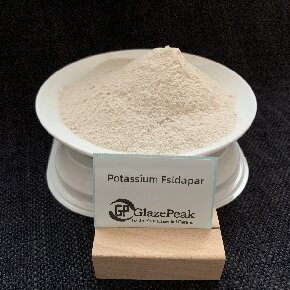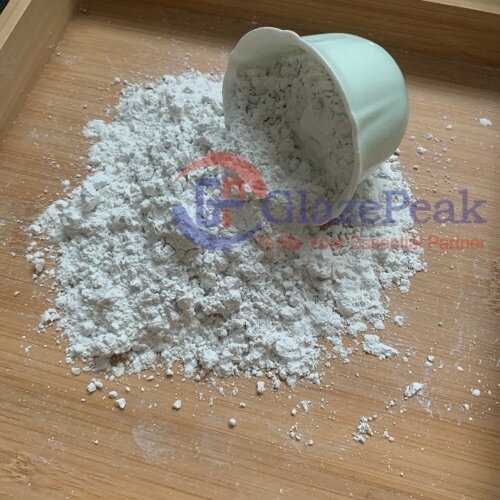
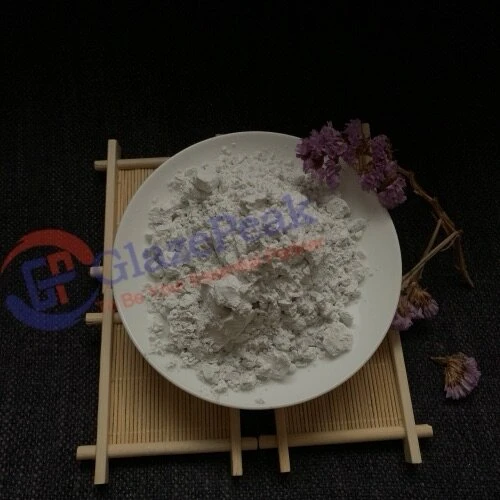
Calcined kaolin serves five core functions in ceramic glazes: reducing shrinkage, stabilizing glaze slip, supplying alumina and silica, adjusting thermal expansion, and enhancing whiteness.
It is mainly used to partially replace raw kaolin. Typical dosage ranges from 3–10 wt%. The common mixing ratio of raw kaolin to calcined kaolin is 1:1 to 1:3.
1. Basic Properties
Calcined kaolin is an anhydrous aluminosilicate produced by heating raw kaolin at 600–1000℃ to remove crystal water.
Chemical composition: Al₂O₃ 35%–40%, SiO₂ 50%–55%, Loss on Ignition (LOI) <1%.
Structural features: Reconstructed crystal structure, non-plastic, low shrinkage, high whiteness, weak suspension capacity.

2. Core Functions in Glazes
2.1 Reduce drying and firing shrinkage to prevent cracking and crawling
Raw kaolin has high shrinkage (>15%). When its proportion exceeds 15%, glaze defects such as dry cracking, crawling and delamination tend to occur. Calcined kaolin exhibits nearly zero shrinkage. Partial replacement of raw kaolin can greatly cut the overall shrinkage of glaze layers. It is especially suitable for high-clay glazes, thin glazes and high-temperature glazes.
2.2 Stabilize glaze slip rheology; balance suspension and flowability
Raw kaolin provides suspension and thixotropy. However, excessive raw kaolin makes the glaze slip overly viscous, hard to apply and prone to agglomeration. Calcined kaolin has no suspending power, yet it helps thicken slip, prevent sedimentation and improve levelling. Blended with a small amount of raw kaolin, it achieves both stable slip and good workability.
2.3 Supply alumina & silica; adjust glaze hardness, refractoriness and gloss
As a major alumina source, it raises glaze melting temperature, high-temperature viscosity, surface hardness, wear resistance and chemical durability. Proper addition brightens whiteness, improves transparency and promotes uniform colour development.
2.4 Tune thermal expansion coefficient to improve body-glaze fit
It lowers the thermal expansion coefficient of glazes and reduces crazing, ideal for low-temperature glazes and ceramic bodies with high thermal expansion. It can partially replace quartz or alumina powder, avoiding glaze devitrification and gloss loss caused by overdosing of single raw material.
3. Application Methods & Formulation Principles
3.1 Replacement Method (Most Common)
eplacement ratio: raw kaolin substituted by calcined kaolin at mass ratio 1:0.8 ~ 1:1. Recommended formula combination: 5%–10% raw kaolin for suspension; 3%–10% calcined kaolin for shrinkage control. Example: Original formula with 20% raw kaolin → revised to 8% raw kaolin + 10% calcined kaolin. Total clay content 18%, shrinkage decreases significantly.
3.2 Direct Addition Method
When raw kaolin content in glaze ≤10%, directly add 3%–8% calcined kaolin to enhance glaze hardness, whiteness and stability.

4.Washed Kaolin vs Calcined Kaolin for Ceramic Glazes: How to Distinguish & Select
A common question from customers:
How to tell washed kaolin apart from calcined kaolin?
Here is our practical explanation: In ceramic glaze slips, washed kaolin mainly acts as a suspending agent. Its platy particle structure supports other powder raw materials and prevents sedimentation, ensuring homogeneous glaze slip. It also delivers good adhesion during glazing application for easy operation.
Calcined kaolin is different. After high-temperature calcination, its crystal structure transforms. It has weak suspension capacity, yet gains superior whiteness and purity. It is the ideal choice to increase glaze surface whiteness and mask discoloration from ceramic bodies.
The core rule for glaze formulation is straightforward: choose washed kaolin when you need stable glaze slip suspension; choose calcined kaolin for a clean, bright glaze surface.
Our in-stock calcined kaolin has whiteness above 90, suitable for whitening and enhancing glaze clarity, with consistent long-term supply.
Washed kaolin for suspension; calcined kaolin for whiteness. The right selection saves trials and errors in glaze recipes.
| Product Name | SiO₂ | Al₂O₃ | CaO | MgO | K₂O | Na₂O | Fe₂O₃ | TiO₂ | B₂O₃ | ZnO | BaO | SrO | P₂O₅ | LOI |
| Calcined Kaolin | 51.81 | 46.25 | 0.09 | 0.08 | 0.08 | 0.02 | 0.23 | 0.93 | N.D. | N.D. | N.D. | N.D. | N.D. | 0.22 |
Hot Tags: calcined kaolin, China calcined kaolin manufacturers, suppliers, factory, Calcined kaolin for strength improvement, Inert filler for sanitaryware, kaolin for ceramic bodies, mineral raw materials, nepheline for thick glaze systems, talc powder