


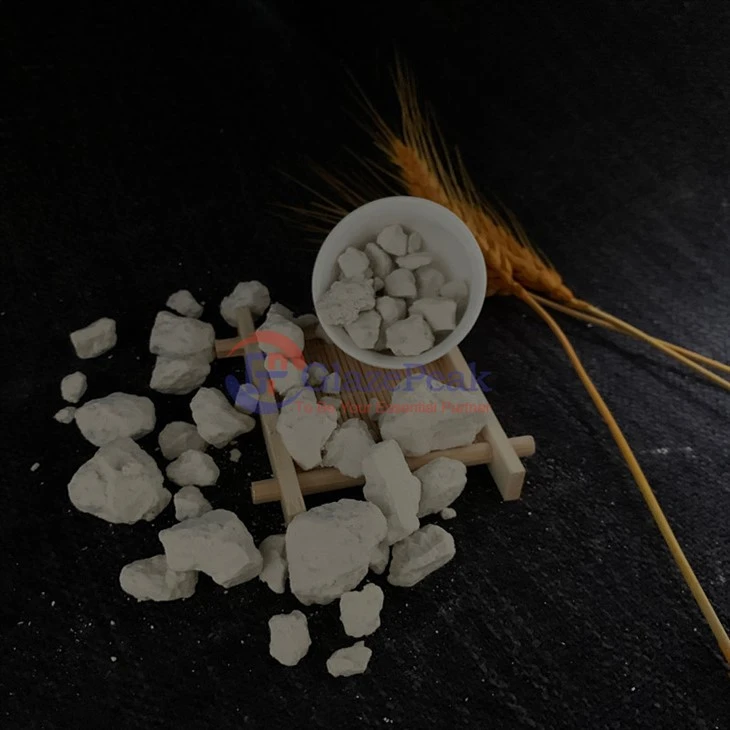


GP-08 is not selected only because it is a washed kaolin.
Its tubular particle structure is the more useful part. In a glaze slurry, the particles help hold water and keep heavier materials from settling too quickly. This becomes noticeable during storage, spraying, dipping, or any production line where the glaze cannot be mixed again every few minutes.
The calcined grade does another job.
After calcination, kaolin loses most of its plastic behavior. It will not make a body easier to form, and it will not support glaze suspension in the same way as GP-08.
What it gives you is a more stable aluminosilicate material. Less firing loss. Less movement during firing. A cleaner way to adjust the solid part of a body, casting slip, or ceramic formula without adding more plastic clay.
So these two materials are not direct substitutes.
Use GP-08 when the production problem is linked to water, forming, or slurry behavior. Look at calcined kaolin when the formula already has enough workability, but the fired result still needs better control.
GP-08 and Calcined Kaolin Comparison
|
Property |
GP-08 Washed Kaolin |
Calcined Kaolin, 325 Mesh |
|
Main job |
Plasticity and suspension |
Shrinkage and shape control |
|
Whiteness |
86–88 |
91–92 |
|
LOI |
About 12% |
Below 1% |
|
Behavior in water |
Plastic and suspension-friendly |
Almost no plasticity |
|
In ceramic bodies |
Helps forming and workability |
Adds stable solid material |
|
In glaze |
Helps slow down settling |
Limited suspension effect |
|
During firing |
Higher weight loss and shrinkage |
Lower firing loss |
|
Better suited for |
Bodies and glaze slurry |
Sanitaryware, casting bodies, filler use |
If the problem starts in the slurry or forming stage, look at GP-08 first.
If the problem appears during drying or firing, calcined kaolin is usually the more useful direction.
Where Do These Two Kaolin Grades Actually Help?
When glaze settles during storage,A glaze may look fine after ball milling, but a thick layer starts forming at the bottom after standing for a few hours.
This is where GP-08 becomes useful.
Its tubular particles help hold the slurry together. For dipping, spraying, or longer production runs, this can mean fewer mixing interruptions and a more even glaze application.
This is the main reason people test kaolin for glaze suspension.
When the body feels short during forming.Some ceramic bodies crack easily at the edge or feel difficult to shape.
In that case, the formula may need more plastic clay, not more calcined material.
GP-08 washed kaolin can be tested for plasticity improvement in tableware, sanitaryware, and casting bodies. Calcined kaolin will not solve this problem because it has almost no plasticity left.
When sanitaryware pieces move too much in firing.Large sanitaryware pieces are sensitive to shrinkage.
A small change in the body can show up as deformation, size variation, or poor fitting after firing.
This is where calcined kaolin for sanitaryware makes more sense. It adds aluminosilicate material with very low firing loss, without bringing more plastic shrinkage into the body.
When a casting body needs better shape control. Casting slip needs enough flow for mould filling, but the piece still has to hold its shape after demoulding and firing.
A 325 mesh calcined kaolin can be used in casting body adjustment when the formula already has enough plasticity but still moves too much during drying or firing.
When a cleaner fired color is needed.The calcined grade has a whiteness of about 91–92. It will not cover iron or other coloring impurities already present in the formula. But it gives you a cleaner aluminosilicate source than a darker clay.
This is useful in light-colored bodies, white sanitaryware, and ceramic formulas where fired color matters.

FAQ
Q: Can I replace washed kaolin with calcined kaolin?
A: Not one for one. Remove too much washed kaolin, and the body may lose plasticity. The glaze may also settle faster.
Calcined kaolin is better used as part of the adjustment, not as a full replacement.
Q: When should I try GP-08 first?
A: Look at GP-08 when the problem starts before firing.
Poor suspension. Fast settling. Weak plasticity.
A body that feels difficult to form.
These are the situations where washed kaolin usually makes more sense.
Q: When is calcined kaolin the better choice?
A: Choose it when the problem shows up during drying or firing.
Too much shrinkage.Shape movement.Size variation.A fired color that is not clean enough.
In that case, 325 mesh calcined kaolin is usually the more useful direction.

Start from the Problem, Not the Product Name
Is the trouble in the slurry or forming stage?Look at GP-08 first.
Is it showing up after drying or firing?
Then calcined kaolin may be closer to the answer.
Share the problem you are seeing in production. A photo, formula direction, or simple description is enough for us to discuss the first test.
Hot Tags: kaolin and calcined kaolin, China kaolin and calcined kaolin manufacturers, suppliers, factory, ceramic grade nepheline syenite, Inert filler for sanitaryware, Kaolin for plasticity improvement, nepheline for vitreous sanitaryware body, Nepheline syenite powder, washed kaolin for ceramics


