


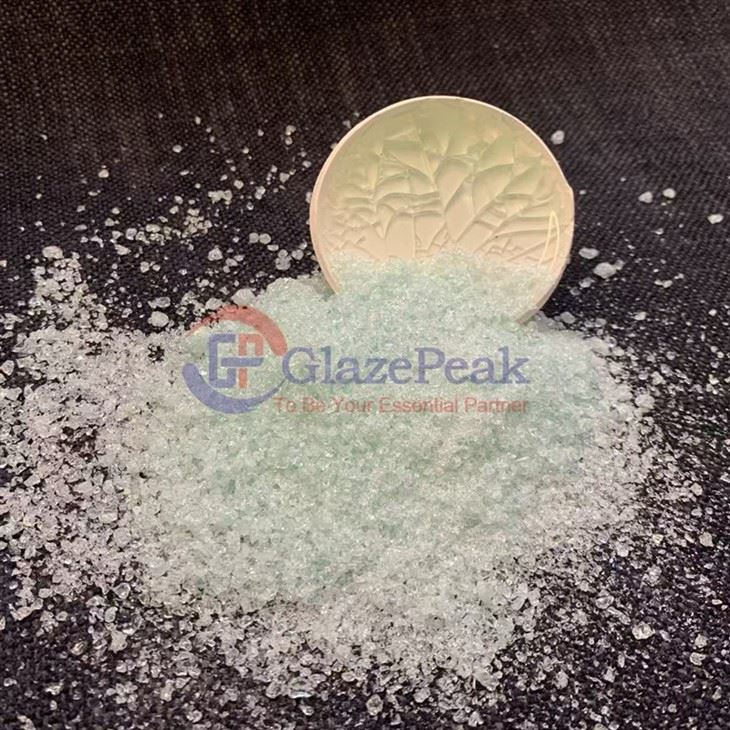
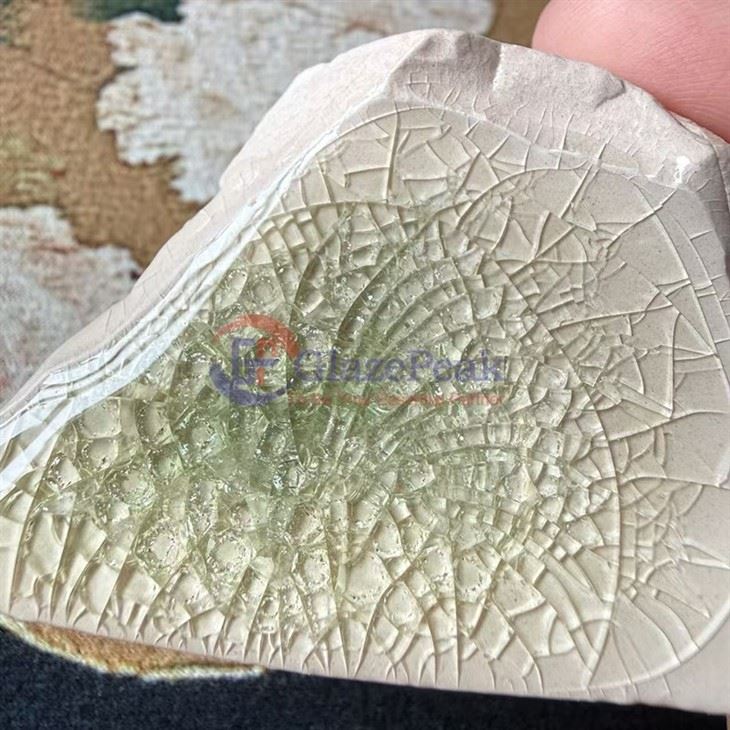
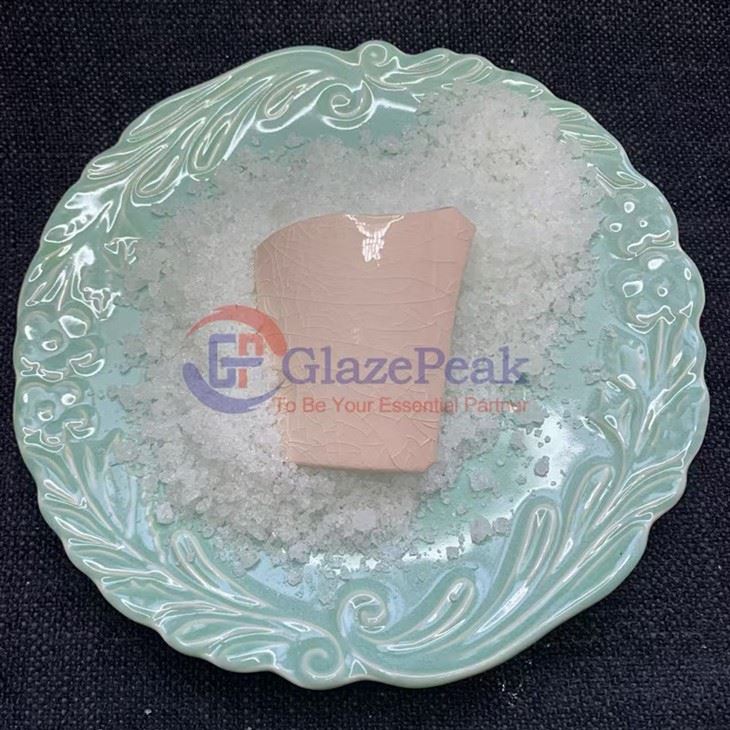
Start with your firing temperature first.
The table helps you compare GlazePeak crackle frit grades by firing range and COE. A higher COE usually means the glaze has a stronger tendency to open crackle during cooling, while a lower COE gives you more room to control the surface.
|
Crackle Frit |
||||||
|
Item |
Product Code |
Soften Temperture(°C) |
Firng Temperture(°C) |
Coefficient Of Expansion (*10-7/°C) |
Firing times |
Appearance |
|
1 |
GP-6305# |
650-680 |
900-1000 |
280 |
One and two times |
Granular |
|
2 |
GP-6626# |
620-650 |
900-1000 |
300 |
One and two times |
Granular |
|
3 |
GP-198# |
68-720 |
1100-1150 |
350 |
One and two times |
Granular |
|
4 |
GP-313# |
550-650 |
700--850 |
420 |
One and two times |
Granular, powder |
|
5 |
GP-316# |
650-680 |
950-1000 |
400 |
One and two times |
Granular |
|
6 |
GP-5519# |
700-800 |
1100-1150 |
390 |
One and two times |
Granular |
|
7 |
GP-598# |
680-720 |
950-1050 |
380 |
One and two times |
Granular |
In practice, firing temperature tells you whether the Crackle frit can melt properly in your system. COE gives you an early idea of how strong the crackle tendency may be after cooling. If you want a more obvious crackle pattern, for example,Fine crackle frit or Large crackle frit, higher expansion grades such as GP-313# or GP-316# are usually worth testing first. If you need a finer or more controlled surface, a lower expansion grade such as GP-6305# may be easier to adjust.
The final crackle pattern still depends on your ceramic body, glaze thickness, and cooling curve. So we do not suggest choosing only by COE. Use the table as a starting point, then confirm the result with sample firing before mass production.
Temperature Range and Grade Selection
GlazePeak supplies Ice crackle glaze frit across several firing ranges:
|
Firing Range |
Typical Grades |
General Use Direction |
|
750–850°C |
GP-313 |
Low-temperature decorative crackle, colored glaze, glazed art pieces |
|
900–1000°C |
GP-316, GP-598, GP-6626, GP-6305 |
Tableware decoration, handmade tiles, medium-temperature crackle glaze |
|
1100–1150°C |
GP-5519, GP-198 |
Higher-temperature crackle glaze, harder ceramic surfaces, decorative porcelain |
For example, GP-313 has a strong low-temperature melting character, supported by high sodium and boron content. GP-598 is more balanced for medium-temperature firing. GP-198 is more suitable when the glaze needs to mature at a higher firing temperature but still keep a visible crackle effect.
This gives customers room to choose the frit by firing system, not only by surface appearance
Fine Crackle or Large Crackle
If you want a fine crackle effect, you normally need a more controlled expansion gap, a suitable glaze thickness, and stable cooling. A large crackle effect usually needs stronger glaze tension, thicker application, or a body-glaze combination that encourages wider crack formation.
Frit composition matters here. High-alkali systems, especially sodium-based frits, usually increase glaze expansion and make the crackle easier to open. Boron helps the frit melt at lower temperatures, while alumina and calcium keep the glaze from becoming too soft or unstable.
This is why different GlazePeak crackle frit grades behave differently. GP-313# may be useful when you want a stronger low-temperature crackle, while grades such as GP-6305# or GP-598# may give you more room for adjustment in medium-temperature systems. For higher firing, GP-198# and GP-5519# are better starting points when you still want visible crackle after stronger glaze maturation.
One frit cannot create every crackle style on every body. Your body type, glaze thickness, and cooling curve still need to be tested together with the frit.
Where It Works Well
This frit series is commonly used for:
- Cracked frit used in tableware and decorative porcelain
- Crackle glaze frit for Handmade wall tiles and art tiles
- Glazed roof tiles and architectural ceramics
- Colored crackle glaze using copper, cobalt, iron, or other colorants
- Ceramic art pieces inspired by Ge ware or Tang-style glazed effects
For tableware, crackle is usually used as a decorative surface. If the glaze is intended for direct food contact, the finished product should be tested as a complete fired glaze system.
Colored Crackle Glaze
Crackle glaze becomes more expressive when used with colorants.
Copper can move toward green or turquoise tones.
Cobalt can create blue crackle effects.
Iron can bring warm brown, yellow, or amber tones.
In glazed roof tiles, Tang-style ceramic pieces, and artistic glazes, the crackle pattern often gives depth to the color. The surface is no longer just one flat color. It has movement.
But colorants can also change melt behavior.
So the frit, colorant, and firing curve should be tested together.
How We Check Crackle Frit Before Shipment
For crackle frit, we do not only check the analysis sheet.
We look at melting behavior, glaze clarity, and the fired crackle response under controlled firing conditions. A batch may have the right chemistry, but if the glaze does not melt properly or the crackle response is unstable, it still needs review.
The crackle effect depends on the fired result.
So we judge the frit by how it behaves in the kiln, not only by oxide numbers.

FAQ
Q: Is crackle glaze the same as glaze defect crazing?
A: Not exactly. Crackle glaze is a controlled decorative effect. Crazing becomes a defect when it appears unintentionally or affects product performance.
Q: Can I choose fine or large crackle only by changing the frit?
A: The frit helps, but crackle size also depends on body expansion, glaze thickness, firing temperature, and cooling speed.
Q: Can this frit be used for tableware?
A: Yes, it can be used for decorative tableware glazes. For food-contact surfaces, the finished fired glaze should be tested for safety and stain resistance.
Q: Can it be used with colorants?
A: Yes. It can be adjusted with copper, cobalt, iron, and other colorants to produce colored crackle effects. Trial firing is recommended.
Q: Is it suitable for raku firing?
A: Some customers may test it for raku-style crackle effects, but our main recommendation is based on ceramic glaze firing systems. Raku firing should be tested separately.

Start a Crackle Glaze Test
If you are developing a crackle glaze, send us your firing temperature, body type, target crackle size, glaze thickness, and colorant plan.
Zibo GlazePeak can help you choose a suitable crackle frit grade and suggest a sample testing direction based on your production conditions.
Hot Tags: cracked glaze frit, China cracked glaze frit manufacturers, suppliers, factory, COE 380 glass frit, Cracked Glaze Frit, Frit for inclusion red pigment, low expansion frit for bone china body, Stable B O supply frit, transparent frit for bone china


