Product Overview
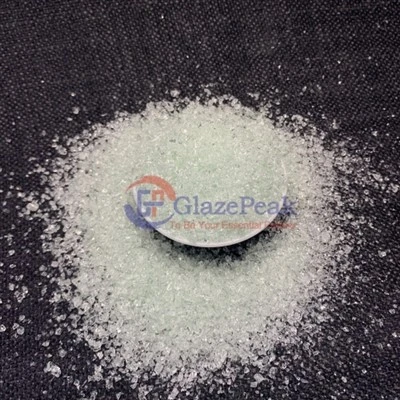
This is a ready-made glaze powder, not a raw material list: a ceramic pottery glaze powder built on a frit core, milled and blended to a finished recipe, so that studios and small manufacturers skip formulation entirely. Four surface families - transparent base glaze powder, opaque white glaze powder, matte finish glaze powder - each supplied in an application-matched version: a fast-wetting dipping glaze powder for hand dipping, and a nozzle-friendly sprayable ceramic glaze for production booths. Every grade ships with a mixing card: water ratio, specific gravity window, application thickness and firing cone, so the same powder mixes the same way every batch.
What a Ready-Made Glaze Must Guarantee
A potter who buys finished glaze powder is not buying chemistry - the chemistry is our job. What they are actually buying is the removal of one specific risk: that this bag fires like the last bag. Everything in our production exists to make that promise keepable:


A frit-locked core.The soluble, drifting components of a glaze are pre-melted into frit, so the chemistry in the bag is the chemistry we verified, not a compromise between hygroscopic raw materials and a damp warehouse.
A fixed milling fineness. Glaze behaviour at every stage - suspension, build, surface - starts at the mill. Our fineness is a specification, checked by sieve residue per batch.
Batch reference tiles. Every production batch is fired at two temperatures and compared against the grade's reference before release. A glaze powder that has not been fired this month is an opinion, not a product.
Dip and Spray Are Different Products
The same glaze chemistry does not behave the same way in a dipping bucket and a spray gun, so we do not pretend one powder serves both.
The dipping glaze powder grades are built for fast wetting on porous bisque: quick, even build in a three-second dip, no streaking on vertical walls, and a suspension that survives a full studio session without hard-settling at the bottom of the bucket.
The sprayable ceramic glaze grades are milled finer and adjusted in rheology for the booth: they atomize cleanly, flow out without orange peel, and will not clog a nozzle mid-session. If your studio sprays, ask for the spray grades - dipping powder pushed through a gun is how spray booths learn pessimism.
The Surface Families
- Transparent base glaze powder - the workhorse: gloss transparency with real depth, stable over underglaze decoration and oxide stains, and the foundation grade most studios keep on the shelf permanently.
- Opaque white glaze powder - zircon-opacified white that covers dark or uneven body colour in one coat range, fires bright without the milky weakness of over-thin opacified glazes.
- Matte finish glaze powder - a satin matte that stays smooth and washable, built as a surface structure that holds its look at the top of its firing range instead of collapsing to gloss.
Mixing and Firing (the card that ships in every bag)
|
Step |
Specification |
|
Water addition |
Start at 0.72–0.85 L per kg powder, adjust to specific gravity 1.40–1.50 |
|
Sieving |
80 mesh (180 µm) before first use; keep the bucket covered |
|
Application (dip) |
3-second dip, 0.5–0.8 mm dry build |
|
Earthenware grades |
1080–1150°C, cone 04–02 |
|
Stoneware grades |
1200–1240°C, cone 5–6 |
The card exists because "mix with water" is where most studio glaze problems actually begin - specific gravity drifts, and the glaze gets blamed.
Technical Data (typical - replace with your lab's certificate values)
|
Property |
Typical value |
Method |
|
CTE, 100–600°C (COE) |
6.0–7.5 × 10⁻⁶/K, matched to standard studio bodies |
Dilatometer |
|
Firing range |
1080–1150°C (earthenware) / 1200–1240°C (stoneware), per grade |
Fired-panel assessment |
|
Specific gravity window |
1.40–1.50 (dip grades) |
Hydrometer, per mixing card |
|
Sieve residue (45 µm) |
≤ 0.5% |
Wet sieve test, per batch |
|
Application |
Dip 0.5–0.8 mm / spray 0.3–0.6 mm dry build |
Thickness-ladder panels |
|
Food-contact grades |
Designated grades only - lead/cadmium release tested |
ISO 6486-type, on the grade sheet |
How We Test It - the Evidence Behind the Claims
Batch reference tiles at two temperatures, photographed against the grade standard, before any bag is released.
Specific gravity and viscosity verification per batch against the mixing card - the numbers on the card must be true on the day the bag opens.
Sieve residue per batch - fineness is a specification, not a hope.
Thickness-ladder panels for dip and spray grades separately, on bisque profiles, not only flat tiles.
Lead/cadmium release testing on designated food-contact grades - and only those grades are sold as food-safe. If the grade sheet does not say it, do not put coffee in it.
Sample Request
Order a 100 g sample of any grade - it ships with the mixing card, so your test fires under the same rules our reference tiles do. Tell us your body, your cone, and whether you dip or spray; for food-contact use, say so explicitly and we will only quote the tested grades.
FAQ
Start at 0.72–0.85 L per kg and adjust to specific gravity 1.40–1.50 with a hydrometer - the mixing card in the bag carries the exact window for your grade. Eyeballing water addition is the single most common cause of "my glaze changed".
Yes - the transparent base grade is designed for it, and stays clear without clouding at the top of its range. Use the earthenware version under cone 04–02 and the stoneware version under cone 5–6.
Only the grades marked as food-contact grades, which are lead/cadmium release tested per ISO 6486-type testing - the grade sheet states it. We will not extend that claim to grades that were not tested, which is why we ask what your ware is for before quoting.
Almost always thickness or firing: applied too thick, or the kiln was still climbing when the surface sealed. The mixing card's application window exists for this reason - stay inside it and pinholes are rare.
Yes - same chemistry family, different rheology. The reference tiles are fired from each version, so if you switch application method, the surface looks the same.
Call to Action
A studio glaze should be one decision you never think about again. Send us your body and cone, order the 100 g samples with their mixing cards, and judge the powder the way we do - fired, against a reference, at two temperatures.
Contact Glaze Peak (Zibo Glaze Peak New Materials Technology Co., Ltd.) for samples, grade sheets, or help choosing between the dip and spray families.
Hot Tags: ceramic pottery glaze powder, China ceramic pottery glaze powder manufacturers, suppliers, factory, High lead frit for crystal glaze, high lead frit for metallic glaze, lead bisilicate frit, lead frit for ceramics, lead glass frit, Lead silicate frit