

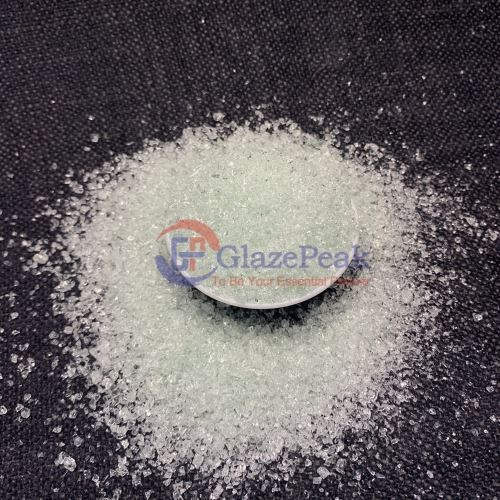


1. Product Overview
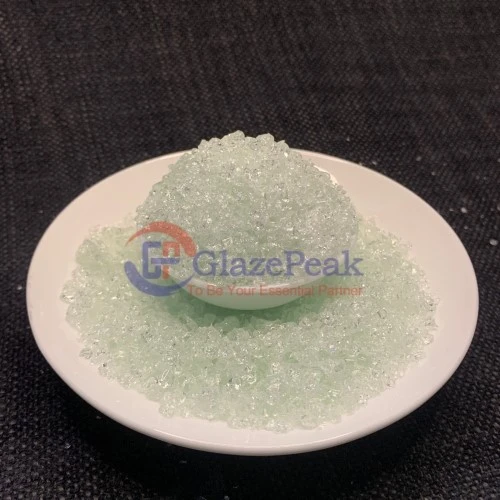
This white frit is a zircon-based premelted glassy frit, also known as our high brightness zircon frit. Raw materials are fully melted inside our high-temperature smelting kilns, locking zircon opacifying phases evenly within the glass network. This sets it apart from the practice of directly adding zircon powder on-site.
It features a stable firing range of 1080–1130°C and a thermal expansion coefficient controlled at 170–180 ×10⁻⁷/°C. Strict in-house checks ensure its lightness value consistently stays above L>92. It is specially developed for porcelain tile and dental porcelain frit applications, to deliver clean, stable high-opacity bright white glaze surfaces.
2. Product Features, Advantages & Application Scope
Let's start with its core features. Manufactured via premelting synthesis, its zircon opacifying crystals are not simply physically mixed but uniformly dispersed in the glass matrix.
Its fixed firing window runs from 1080°C to 1130°C, with thermal expansion kept steadily between 170–180 ×10⁻⁷/°C. Every finished batch goes through tests in our internal laboratory, including XRF composition analysis, chromaticity inspection, thermal expansion measurement and particle size screening, to maintain stable L>92.
Its advantages are summarized from repeated firing tests on production lines: First, its expansion range matches most mainstream porcelain tile bodies on the market and greatly lowers the risk of glaze crazing.
Second, it offers good firing tolerance. Minor temperature fluctuations inside roller kilns will not easily ruin the whiteness and opacity of the glaze layer. Third, frit powder disperses well in glaze slip. Compared with raw zircon powder, it settles much slower and keeps slip performance stable during glazing.
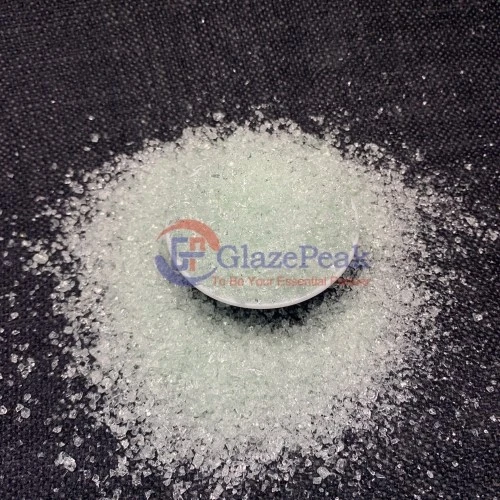
Fourth, it delivers a clean neutral white tone and is less prone to yellowish tint. Fifth, the premelting process reduces raw material batch variation. Colour consistency is reliable in mass production, and frequent colour adjustment is unnecessary.
Application scope: Primarily designed as white glaze over transparent base for porcelain tile. It also fits dental porcelain frit systems. Suitable for standard fast-firing roller kiln lines, ideal for glaze recipes requiring high whiteness, uniform opacity and reliable batch stability.
3. Product Application: Common Glaze Line Problems It Solves
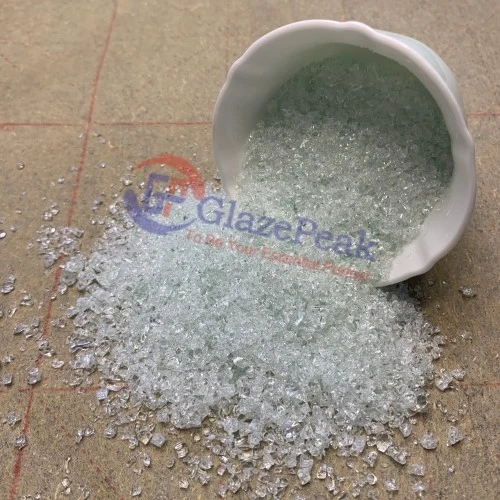
We communicate daily with many glaze formulators and shop-floor technicians, and they often run into the same set of white glaze issues. This white frit is engineered to ease these pain points.
Many factories use raw zircon powder directly for opacification and whitening. Zircon powder tends to agglomerate easily. Poor dispersion after ball milling leads to uneven glaze surfaces, mottling and spots after firing. Switching to this premelted white frit eliminates agglomeration risks because zircon phases are already evenly distributed during melting.
Another frequent headache is yellowish glaze base and obvious whiteness deviation between shifts or kiln runs, which generates high reject and rework rates.
This frit is produced with strict impurity control for a stable neutral base tone and locked L>92 brightness, effectively reducing colour inconsistency.
Some technicians struggle with glaze crazing after cooling due to mismatched thermal expansion between body and glaze. Our white frit has a fixed COE of 170–180 ×10⁻⁷/°C, matching standard porcelain bodies and minimising crazing.
Direct addition of zircon powder also disturbs the colloidal system of glaze slip. Fast sedimentation and unstable fluidity make it hard to maintain consistent glaze thickness during pouring or spray glazing. This premelted opacifier creates less disturbance to glaze slip, supporting stable continuous production.
Besides, raw-glaze formulas take a long time to tune. Every new batch of zircon ore requires a full round of test firing. Using this ready-made frit shortens formulation trials and cuts your testing cost.
4. Comparison
Comparison 1: Premelted white frit VS raw zircon powder added directly in formula
Whiteness stability: Zircon powder performance varies greatly with ore source, impurities and milling quality, causing obvious colour drift. Our premelted frit has controlled batch chromaticity with steady L>92 for superior white consistency.
Glaze slip behaviour: High-density zircon powder settles rapidly and agglomerates. Frit powder disperses better, slows sedimentation and stabilises glaze thickness.
Crazing risk: Zircon powder only provides opacity without tuning thermal expansion. This frit has fixed COE for better body-glaze matching and lower crazing risk.
Formulation workload: Zircon powder requires re-calibration with every new raw material lot. Frit has fixed indicators with minimal formula changes and far fewer firing trials.
Final glaze finish: Poorly dispersed zircon powder causes mottling and pinholes. Frit delivers uniform opacity for smooth, clean glaze surfaces.
Comparison 2: Our L>92 white frit VS ordinary zircon frits on the market
Many commercial zircon frits have low L values, weak whiteness and a tendency to turn yellow. Our grade maintains stable L>92 for a crisp neutral cool white. Common low-cost frits have narrow firing windows; small kiln temperature shifts will break opacity. Our frit has a forgiving 1080–1130°C firing range. Many budget alternatives skip strict COE control and trigger mass crazing issues. We test thermal expansion for every batch and lock it within 170–180 ×10⁻⁷/°C for dependable performance.
5. FAQ
Technical Questions
FAQ
Q1: What is the recommended firing temperature and COE for this white frit?
Q2: What does L>92 mean, and how does it look visually?
Q3: Can I replace zircon powder in my formula with this frit at the same weight?
Q4: Will it cause defects when applied in thick glaze layers?
Q5: Can whiteness be adjusted? Do you support custom frit development?
Company & Cooperation Questions
Q1: What production capacity does Zibo Youshang have, and what tests can your laboratory perform?
A: Rooted in Zibo, China's ceramic capital, we run two high-temperature smelting kilns to produce a full range of frits. Our in-house laboratory supports XRF chemical testing, chromaticity analysis, thermal expansion testing, particle size distribution measurement and melt behaviour evaluation. Test records are kept for every batch.
Q2: Can I get samples for trial firing? Are test reports included with samples?
A: Free samples are available for firing evaluation. Each sample set comes with the corresponding batch test report covering chromaticity, COE and chemical composition to support your side-by-side testing.
Q3: What is the MOQ and typical lead time?
A: We offer low minimum order quantities for standard stock frits with fast delivery. Customised grades require discussion on lead time after receiving your formulation and firing requirements.
Q4: Can you adjust the frit if our ceramic body and firing curve are special?
A: Yes. Our technical team will collect details of your body composition, kiln schedule and target glaze effect, then adjust frit formulations and run repeated lab trials to fit your production line.
Q5: How do you guarantee batch consistency for bulk orders?
A: Full-process quality control covers incoming raw material inspection, real-time parameter monitoring during melting and finished batch sampling. Any batch failing specification will not be shipped. We can share batch test data regularly for long-term partners.
Hot Tags: white frit, China white frit manufacturers, suppliers, factory


