

Product Overview
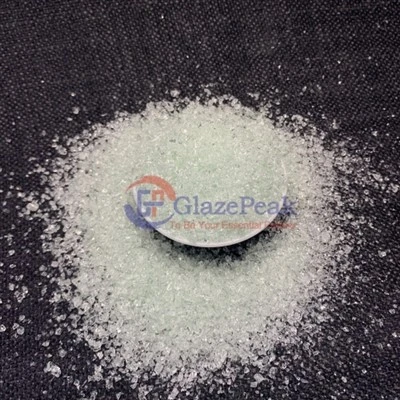
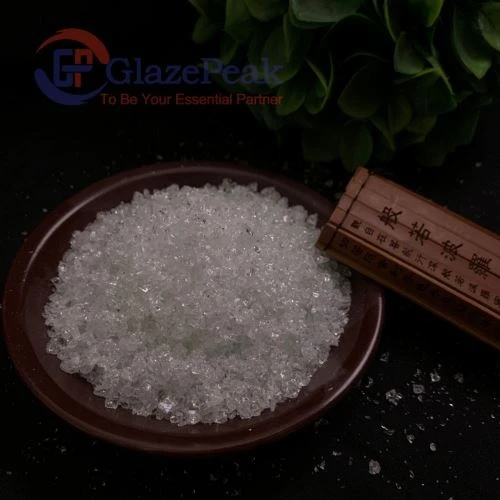
A reactive glaze is built from oxide pairs that do not dissolve quietly into each other - iron meeting titanium, calcium meeting magnesia, manganese meeting silica. During cooling they separate, blend and locally crystallize, and the glaze surface turns into a pattern no brush could paint: mottled variegation, rust-to-cream blending, crystals ringing the rim of a pot. This family supplies that chemistry as a pre-melted frit powder for plant pot manufacturers and gardenware brands - grades for variegated glaze frit effects, crystalline reactive glaze frit surfaces, textured lava flow or volcanic glaze finishes, and blends for color blending plant pot glaze programmes, all formulated to mature in a single-fire reactive glaze frit process on terracotta and stoneware bodies.
What "Reactive" Actually Means

In a uniform glaze, every oxide finds a home in the glass network and the fired surface repeats the mill formula. In a reactive glaze, selected oxides are deliberately kept at odds: they refuse full solution, and as the glaze cools through its softening range they separate into coexisting phases, blend along thickness gradients, and crystallize where the chemistry is locally saturated. Iron and titanium are the classic pair - together they paint the rust, cream and blue-grey mottling that plant pot buyers keep asking for.
This is why a reactive surface changes with everything: firing temperature, cooling speed, glaze thickness, even the porousness of the terracotta beneath. The pattern is painted by the process, not just by the recipe.
Designed Unpredictability - the Window Is the Product
Honesty first: a reactive glaze will never fire two identical pots, and that is the point of buying it. What separates a supplier worth having from a bag of surprises is whether the range of outcomes is controlled.
Ours is, and here is how it is verifiable. Every grade is fired as a reference panel set - three temperatures, two application thicknesses - photographed and archived. Every production batch is then fired against its own reference and compared before release. When you buy a variegated glaze frit grade from us, the sample tile in your hand defines the family of outcomes your pots will fall inside: palette, contrast level, and texture density. Variation between pots stays; drift between shipments does not.
Single-Fire Economics - Built for Pot Margins
Plant pots are a volume business, and every extra firing is margin leaving the company. These grades mature low enough to fire once with the body - bisque and glaze in a single pass at 1120–1180°C on terracotta. That is one kiln cycle removed from your cost structure, on the product category where kiln time is most of the cost.

Forgiveness in Application
Pot lines are fast, and glaze application is run by people, not laboratory robots. This powder was engineered for that reality:
Wide thickness window - 0.8–1.5 mm applied wet, without the pattern collapsing thin or muddying thick
Stable suspension - the frit-based body resists hard settling, so the dip tub survives a full shift without constant stirring
Consistent batch behaviour - same water addition, same viscosity, batch after batch, verified against the reference panel
That is what "easy to use reactive glaze powder" has to mean in a working plant, and it is the standard we hold the product to.
Grade Selection
|
Grade |
Answers the question |
Typical surface |
|
Variegated glaze frit |
"Rust-to-cream mottling for outdoor pots?" |
Iron–rutile mottle, soft blending |
|
Crystalline reactive glaze frit |
"Crystals ringing rims and shoulders?" |
Local crystal clusters on a variegated ground |
|
Lava flow or volcanic glaze |
"A textured, tactile black or dark brown?" |
Bubbled volcanic texture, 0.5–2 mm relief |
|
Color blending plant pot glaze |
"Gradient blends across one pot?" |
Two-tone blend grades, mixable in the dip tub |
|
Single-fire reactive glaze frit (platform) |
"Which one for a terracotta single-fire line?" |
The reference grade - 1120–1180°C, forgiving window |
Technical Data (typical - replace with your lab's certificate values)
|
Property |
Typical value |
Method |
|
Reactive system |
Fe₂O₃ / TiO₂ / MnOₓ combinations, per grade |
XRF |
|
CTE, 100–600°C (COE) |
5.5–6.8 × 10⁻⁶/K, matched to terracotta and stoneware bodies |
Dilatometer |
|
Firing range (single fire, terracotta) |
1120–1180°C |
Fired-panel assessment |
|
Firing range (stoneware grades) |
1180–1230°C |
Fired-panel assessment |
|
Application window (wet) |
0.8–1.5 mm |
Thickness-ladder panels |
|
Particle size |
80–200 mesh |
Laser diffraction |
|
LOI |
≤ 0.5% |
950°C ignition loss |
|
Frost / crazing cycling |
Pass grade threshold for outdoor pot use |
Moisture–freeze cycling on glazed pots |
How We Test It - the Evidence Behind the Claims
Reference panel system per grade: three temperatures × two thicknesses, fired, photographed, archived; every production batch is judged against its own reference before release.
Thickness-ladder panels: the applied-wet window (0.8–1.5 mm) is verified on real pot profiles, not flat tiles only.
CTE per batch on the dilatometer - a reactive glaze that crazes outdoors will spall after a winter, so expansion is treated as a safety property, not a footnote.
Moisture–freeze cycling for grades sold as frost-resistant outdoor finishes.
COA with every batch: chemistry, particle size, melt behaviour, CTE - plus the reference panel photo ID for the effect.
Sample Request
Send us three things: your body (terracotta or stoneware), your firing curve, and a photo of the effect you are chasing - a pot you liked, a competitor piece, or a mood image. We will return fired panels on your body parameters at three temperatures, so you see the reaction window before you commit a kiln load.
FAQ
Q1. Will every pot look the same?
No - and that is the product. What we control is the window: palette, contrast and texture density stay inside what the reference panel shows. Pot-to-pot variation is the look buyers want; shipment-to-shipment drift is the failure we test against.
Q2. Why does my current reactive glaze look different every delivery?
Most likely the effect was never reference-locked. Without a fired panel standard, each batch drifts - oxide ratios, melt completion, milling fineness all move the pattern. Our reference system exists precisely to remove that drift.
Q3. Can it run single-fire on cheap terracotta?
Yes - that is what the platform grade is built for: 1120–1180°C, one firing, glaze and body maturing together. Tell us your body's firing range and we will confirm the grade fit.
Q4. Is the volcanic texture safe to touch and clean?
The lava texture is real relief (0.5–2 mm), so it is tactile by design. It wipes clean, but we recommend keeping it off saucer rims and seating surfaces where soil and water si
Q5. Will it craze on outdoor pots in winter?
Crazing plus frost is what kills outdoor glazed pots - water enters the crack and spalls the glaze. The CTE is matched to the body and the outdoor grades pass moisture–freeze cycling. Your body must do its part too: a porous, weak terracotta will limit any glaze's outdoor life.
Call to Action
A reactive glaze sells variation - but only a supplier who fires reference panels can promise where the variation stops. Send us your body and firing curve, request the three-temperature panel set, and see the window before you fill a kiln.
Contact Glaze Peak (Zibo Glaze Peak New Materials Technology Co., Ltd.) for samples, grade sheets, or help matching an effect you are currently buying elsewhere.
Hot Tags: reactive glaze plant pot glaze, China reactive glaze plant pot glaze manufacturers, suppliers, factory, Lead flux for low temperature firing, lead frit for artistic glaze, lead frit for ceramic tableware, lead frit for ceramics, lead glass frit, low lead frit