Product Overview
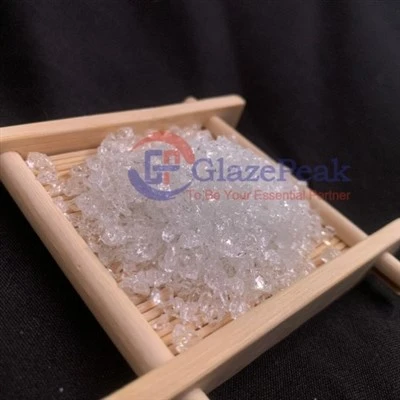
A microcrystalline melt frit is a glass that has been designed to stop being glass on cue. It melts, casts and grinds like any frit - then, inside the firing, built-in nucleating agents trigger a controlled wave of crystal growth through the body. What leaves the kiln is a glass-ceramic: a fine crystal phase dispersed in a glass matrix, combining the processability of glass with the hardness and stability of a crystalline ceramic.
Glass Is the Raw Material; the Crystal Is the Product
Ordinary devitrification is an accident: crystals grow where they please, large and uneven, and the surface ends up streaked, weak or dull. Controlled crystallization is the opposite - a planned event with a nucleation stage, a growth stage, and chemistry that keeps both inside known limits.
Our frits carry their own nucleant package - titanium, zirconium and phosphorus oxides balanced into the melt - so crystals nucleate densely and evenly instead of at a few lucky sites. Dense nucleation is what keeps crystal size down: tens of nanometres to a few microns depending on grade, uniform across the panel, repeatable across the batch. The frit sets the plan; your kiln executes it.


-
iShenzhen Mandarin Oriental Hote
Controlled crystallization frit - the platform grade. Predictable nucleation, a wide and forgiving crystallization window, and a crystal phase we verify by XRD on every development batch. Start here unless you have a reason not to.
Nano-crystalline frit - crystals held below the scale that scatters visible light. You gain hardness and abrasion resistance while the surface stays transparent or cleanly translucent - the grade behind hard, clear wear layers and nano-polished glazes.
High strength microcrystalline frit - micro-scale crystals that interrupt crack paths: a crack running through the surface has to detour around every grain. Measured effect: Vickers hardness typically 15–25% above the parent glass, with noticeably better edge-chip behaviour on polished tile.
Artificial marble frit - engineered for microcrystalline stone panels: high fired whiteness, a uniform fine-grained body that polishes to a deep gloss, and water absorption under 0.1% - so the slab behaves like stone but stains like glass, meaning it doesn't.
Typical Specification (grade-dependent)
|
Item |
Typical value |
|
Crystal phase |
β-wollastonite / diopside system, XRD-verified |
|
Crystal size |
50 nm – 3 µm, by grade |
|
Softening point |
~750–800°C |
|
Sintering / crystallization (panels) |
1050–1150°C |
|
Glaze firing window |
1150–1220°C |
|
CTE, 100–600°C (COE) |
~5.5–7.0 × 10⁻⁶/K |
|
Fired water absorption |
< 0.1% |
|
Grain size |
80–200 mesh, per request |
How Every Batch Is Verified
Chemistry alone cannot certify a glass-ceramic - a frit can have the right oxide analysis and still crystallize into the wrong phase. So the crystal phase is identified by X-ray diffraction on development batches and held as the reference for production. Hardness is tracked by Vickers indentation against the parent glass; CTE by dilatometer; fired whiteness and colorimetry on panel grades; particle size and melting behaviour by the same methods as every other Glaze Peak frit. The COA in each drum reports what crystallized, not only what was melted.
Applications
Microcrystalline stone and artificial marble slabs, polished glazed tile wear layers, nano-polished transparent glazes, high-abrasion floor surfaces, engineered stone countertops and architectural panels - anywhere a fired surface has to survive contact, cleaning and time without looking manufactured.
FAQ
- How is this different from an ordinary opaque frit? An opaque frit scatters light from particles that stay particles. A microcrystalline frit grows a crystal phase inside the glass during firing - the crystals become part of the body, which is where the strength and abrasion gains come from.
- Will crystals grow uncontrollably in my kiln? The nucleant package and the crystallization window are built into the frit. Within the recommended firing window, growth stays fine and even; we supply the schedule with the grade.
- Can I polish it like stone? That is what the panel grades are for. The fine, uniform crystal body takes a deep polish, and water absorption under 0.1% keeps the polished surface from staining afterwards.
- Is the surface still transparent with nano-crystals? Yes - crystals below the scattering scale for visible light add hardness without haze. That is the entire point of the nano grade.
- What data comes with a trial? COA with chemistry and particle size, plus crystallization data: phase by XRD, CTE by dilatometer, hardness against the parent glass where relevant.
CTA
Planning a microcrystalline stone line or a harder wear layer? Send us the panel size, firing curve and the surface properties you need - hardness, whiteness, transparency. Our technical team will select the grade, confirm the crystallization schedule, and ship trial material with XRD-verified data - usually within one working day.
Request a Sample
Contact our sales team with your application and target properties. Trial lots are certified exactly like production batches - crystal phase included.
Hot Tags: microcrystalline melt frit, China microcrystalline melt frit manufacturers, suppliers, factory, frit for vitrified tiles, high zinc frit for imitation bone porcelain, high zinc frit for soft gloss glaze, high zinc frit for soft matte glaze, titanium glaze frit, zinc frit for velvet glaze