Product Overview
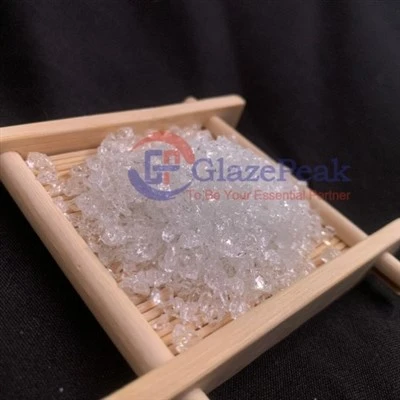
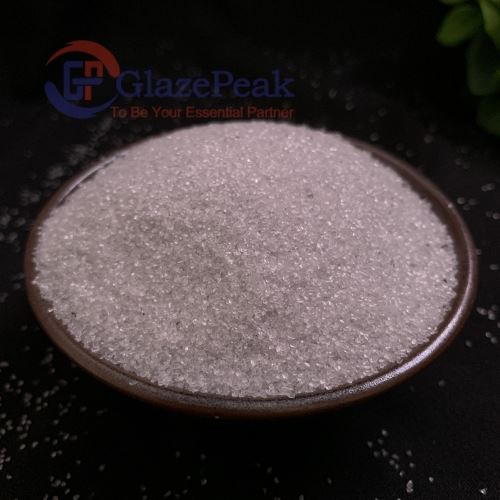
A barium–strontium frit is an alkaline-earth borosilicate glass carrying barium oxide, strontium oxide, or both. These two oxides are the strongest brilliance builders in the glaze maker's toolkit: they raise the refractive index of the glass, flux the melt cleanly, and pull a zircon-opacified white from grey to bright. The frit format exists because the raw carbonates bring problems the fired glass does not.
Why These Two Oxides Look Expensive

Refractive index is the quiet variable behind what buyers call "depth". Light hitting a glaze surface splits: most enters the glass, a few percent reflects straight back at the viewer. That reflected fraction is set by the Fresnel relation - a glass at n ≈ 1.52 returns about 4.3% of the light; push the index to 1.58 with barium and it returns about 5.1%. That is roughly a fifth more surface light before anything else changes. The gloss deepens, blacks look blacker, colours sit further back in the surface.
Whiteness gains differently. Barium and strontium flux strongly, so the melt refines earlier and the zircon opacifier disperses more evenly - fewer residual bubbles, fewer grey shadows, a higher L* at the same zircon loading. Bright white is usually bought with opacifier; here part of it is bought with melt quality.
The Barium Question
Barium carbonate is soluble. In a glaze slurry that means two things: it can migrate and scum on the fired surface, and it leaves a soluble barium salt behind in the working environment. Fritting changes the chemistry of the risk - barium in a frit is locked inside the glass network, and an insoluble barium compound frit does not behave like the carbonate it came from. No dust hazard at the mill, no scumming on stored ware, no soluble barium in the process water.
Then there is the commercial question. Some markets and some customers will not accept barium at all, and arguing with them costs more than reformulating. That is what the strontium version is for.

Where Barium Is Off the Table
A strontium frit lead-free formulation carries the same alkaline-earth mechanism without the barium conversation: high gloss, bright zircon whites, and a story you can print on the box. You give up a little refractive index - strontium sits below barium on the polarizability scale - and gain a glaze that passes through procurement without a second meeting. For most decorative and sanitaryware applications, the difference in depth is not what the customer notices; the difference in paperwork is.
Where the deepest possible gloss matters and barium is permitted, the barium grade stays the reference, with the insoluble barium compound frit doing the work.
The Grades
|
Grade |
What it is for |
|
Barium–strontium frit - platform |
Balanced BaO/SrO system for high-gloss, bright-white glazes |
|
Insoluble barium compound frit |
Maximum refractive index for the deepest gloss, with barium locked in glass |
|
Strontium frit lead-free |
Barium-free, lead-free brilliance for tableware and sanitaryware |
|
Barium-free high gloss frit |
For markets where barium cannot appear on the specification |
|
Strontium frit for bright white |
Zircon-white grades, tuned for L* at fixed opacifier loading |
|
High refractive index frit |
The brilliance platform, n ≈ 1.56–1.60 |
Typical Specification (grade-dependent)
|
Item |
Typical value |
|
BaO (barium grades) |
8–16 wt% |
|
SrO (strontium grades) |
10–18 wt% |
|
Refractive index |
~1.56–1.60 |
|
Firing window |
1080–1220°C |
|
CTE, 100–600°C (COE) |
~6.0–7.2 × 10⁻⁶/K |
|
Whiteness (with standard zircon) |
L* 92–95 |
|
Pb (lead-free grades) |
Not detected by XRF |
How Every Batch Is Verified
Chemistry by XRF, with barium and strontium reported separately - not as "alkaline earths" - because the ratio is what your gloss depends on. Lead is screened and reported on every lead-free batch, so the claim is a number rather than a promise. Colour is measured as L*a*b* on fired plates at your zircon loading, gloss at 60°, expansion by dilatometer, and acid and household-chemical resistance on tile-grade glazes to ISO 10545-13. For food-contact projects, tell us the destination market and we will run the leaching screening that market requires.
Applications
High-gloss wall tile and bright-white porcelain glazes, sanitaryware, tableware where a lead-free barium-free system is specified, decorative and giftware surfaces - anywhere the surface has to look expensive and survive a specification review.

FAQ
Is a barium frit safe for food contact?
Barium in a frit is bound in the glass network, not present as a soluble salt. For food-contact projects we test to the method your market requires rather than assert it - and where barium is unwelcome, the strontium grade removes the question entirely.
How much brilliance do I lose going barium-free?
Measured at the surface, a few tenths of a percent of reflected light - noticeable to a glaze technician comparing plates side by side, rarely to a buyer. We can quote both grades from the same body so you can judge on fired samples.
Will strontium change my expansion and cause crazing?
Strontium sits slightly higher on expansion than barium, so the grade is formulated with that compensated. Expansion is reported per batch; check it against your body before scaling up.
Can it replace barium carbonate one-for-one?
No - substitution is calculated on delivered BaO, and a frit carries it at a different concentration. Send the current recipe and we return the dosage.
Is the lead-free claim verifiable? Yes. Lead is screened by XRF on every batch of the lead-free grades and reported on the COA.
CTA
Under pressure to drop barium without dropping the gloss?
Send us your current glaze recipe, target whiteness and the market you ship to. Our technical team will quote the barium and strontium versions side by side with fired-plate colour and gloss data - usually within one working day.
Request a Sample
Contact our sales team with your zircon loading and firing curve. Trial lots ship with the same COA as production, including the barium/strontium ratio and the lead screen.
Hot Tags: barium–strontium frit, China barium–strontium frit manufacturers, suppliers, factory, high zinc frit for bone china glaze, high zinc frit for imitation bone porcelain, high zinc frit for porcelain glaze, titanium frit for white ceramic glaze, zinc ceramic frit, zinc frit for soft matte glaze